
Bronze metallurgy as cultural engine.
From the copper mines of the Balkans to the ritual vessels of Shang China, bronze metallurgy arose independently — and sometimes interdependently — across an astonishing range of civilizations. This article surveys the full scope of that transformation, well beyond the familiar centers of Mesopotamia and Egypt, into regions rarely given their due in popular accounts of the ancient world.
When we speak of “the Bronze Age,” the phrase itself is a convenient fiction — a single label stretched across a tapestry of cultures separated by thousands of kilometers and, in some cases, thousands of years. The alloy we call bronze (typically copper with 8–12% tin, though arsenic, lead, and other metals were also used) was not discovered once and then transmitted outward from a single origin. It was independently developed, redeveloped, borrowed, adapted, and perfected by societies as different from one another as the Shang court at Anyang and the copper-working communities along the shores of Lake Superior.
Having spent years handling hundreds of ancient copper alloy artifacts — from the massive 480 mm split-socket pike in the Sancta Clara Collection (Lot 32737, a Transcaucasian or Levantine type from the Middle Bronze Age) to diminutive Scythian trilobate arrowheads weighing barely a few grams — I can say that no single typological framework captures the ingenuity of these cultures. Each region left its signature in the metal: in the way a socket was formed, a midrib raised, a blade tempered, or a surface decorated. What follows is an attempt to trace those signatures across the globe.
The Usual Suspects: A Brief Reorientation
Before venturing into less-discussed territory, it is worth sketching the five cultures that dominate most introductory accounts, if only to establish a baseline.
Mesopotamia (c. 3300–1200 BC) gave us the earliest large-scale bronze production in the Near East. Sumerian and later Akkadian metalworkers were casting sophisticated weapons, tools, and votive figures by the mid-third millennium BC. Tin was imported over vast distances — from Afghanistan, from the Taurus Mountains, possibly from as far as Cornwall — feeding an alloy economy that underwrote urban civilization. The Sancta Clara Collection’s Elamite copper arrowheads (such as Lot 117, a massive 142 mm bilobate point dating to 3000–1600 BC) belong to this broader Mesopotamian metallurgical sphere, though Elam itself maintained a fiercely independent tradition.
Egypt developed bronze metallurgy somewhat later than Mesopotamia but applied it with extraordinary refinement. Egyptian arrowhead design is well represented in the Collection — the inscribed arrowheads of Lots 763 and 769, for instance, bear hieratic or hieroglyphic marks that tie them to specific military units or temple arsenals of the New Kingdom. The bilobate leaf-shaped arrowhead with knob (Lot 11491, 18th Dynasty, 1550–1292 BC) exemplifies the Egyptian preference for elegant, aerodynamic forms optimized for chariot warfare.
The Aegean World — Minoan Crete and Mycenaean Greece — represents the European Bronze Age at its most dramatic. Mycenaean swordsmiths produced blades of startling quality: the Sancta Clara Collection’s Mycenaean short sword (Lot 778, 1700–1200 BC, 390 mm) is a case study in functional design, with its cruciform hilt, flanged tang, and carefully balanced blade. These cultures imported tin from the west and copper from Cyprus, establishing trade networks that linked the eastern Mediterranean from end to end.
The Indus Valley Civilization (c. 3300–1300 BC) at Harappa and Mohenjo-Daro produced a distinctive suite of copper and bronze objects — flat axes, chisels, knives, and the famous “dancing girl” figurine — though weapons are notably rare in the archaeological record, a fact that continues to puzzle scholars.
China’s Shang Dynasty (c. 1600–1046 BC) achieved what many regard as the apex of ancient bronze casting. But the Shang did not emerge from a vacuum, and the story of Chinese metallurgy begins much earlier. We will return to China in detail below.
These five are important, but they are the overture, not the opera. Let us turn now to the cultures that seldom appear in popular surveys.
The Balkans and “Old Europe”: Vinča, Varna, and the Earliest Copper
Long before the conventional Bronze Age begins, southeastern Europe was already transforming the human relationship with metal. The Vinča culture (c. 5700–4500 BC), centered in modern Serbia and extending across much of the central Balkans, is among the earliest communities to engage in systematic copper smelting. Vinča metallurgists were producing small copper tools and ornaments from native copper and malachite ore by the fifth millennium BC — contemporaneous with or even preceding the earliest Mesopotamian metalwork.
The nearby Varna culture (c. 4600–4200 BC) on the Black Sea coast of modern Bulgaria is best known for the spectacular gold hoard discovered in the Varna Necropolis in 1972, but the copper objects from that site are equally significant for the history of metallurgy. The Varna smiths were working with high-purity smelted copper, producing heavy shaft-hole axes and adze-axes that anticipate forms that would not become widespread in the Near East for another millennium.
These “Old European” copper cultures did not, strictly speaking, produce true bronze — their alloys were typically copper with elements like silver, lead, zinc and arsenic present in the ore, or arsenical copper. But they established the smelting techniques, the social structures around specialist craft production, and the long-distance exchange networks (for malachite, obsidian, and Spondylus shell) that later Bronze Age cultures in Europe would inherit. The Sancta Clara Collection’s remarkable Eneolithic shaft-hole battle axe (Lot 891, of the Epirus/Kurgan/Veselinovo type) is a direct descendant of this tradition — a weapon form that originated in the Chalcolithic Balkans and spread across a vast territory from the Adriatic to the Pontic steppe.
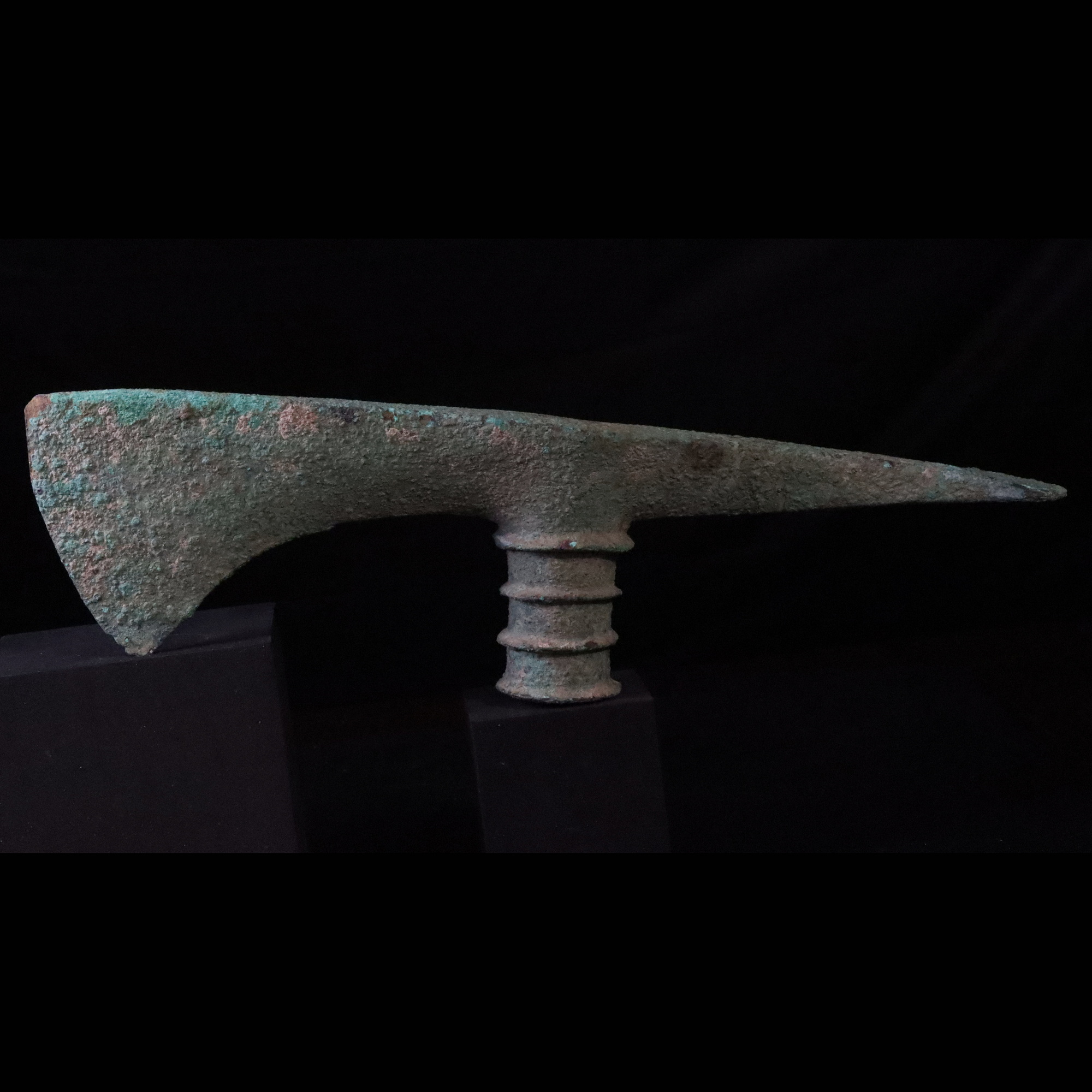
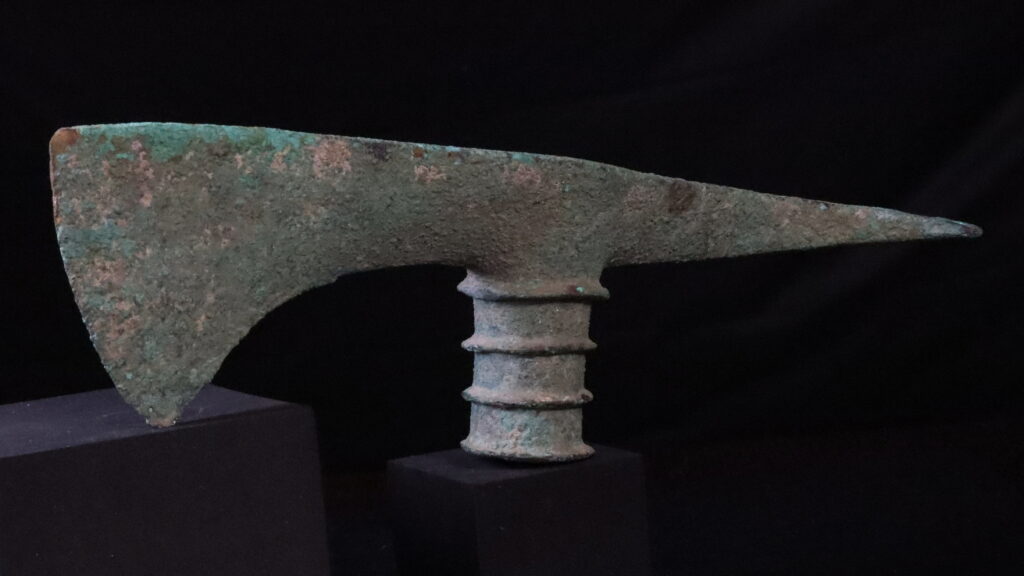
The “Old Europe” copper axe-adze (Lot 43951422), dated to approximately 4300 BC, is one of the Collection’s oldest artifacts and a tangible link to this formative chapter. Its flat, trapezoidal blade and simple shaft-hole represent a technological solution that remained in use, with refinements, for three thousand years.
The Carpathian Basin: Únětice, Otomani, and the Arsenical Tradition
The Carpathian Basin — roughly modern Hungary, Slovakia, western Romania, and parts of Austria — was one of the richest metallurgical zones in prehistoric Europe. Copper and gold deposits in the Transylvanian Alps and the Slovak Ore Mountains (Slovenské Rudohorie) fueled a succession of cultures that produced increasingly sophisticated bronze artifacts.
The Únětice culture (c. 2300–1600 BC) of Central Europe is best known for the Nebra Sky Disc, but its contribution to bronze weapon typology is equally remarkable. Únětice metalworkers developed early flanged axes, halberds, and distinctive “Apa-type” swords with solid hilts — precursors to the great European sword traditions of the later Bronze Age.
The Otomani culture (c. 2000–1400 BC), overlapping geographically with eastern Únětice, produced a denser and more martial material culture: heavy socketed spearheads, daggers with multiple rivets, and elaborate gold ornaments. The transition from arsenical copper (where arsenic acts as a natural hardening agent, absorbed from the ore itself) to deliberate tin-bronze alloying can be traced through Carpathian assemblages with particular clarity.
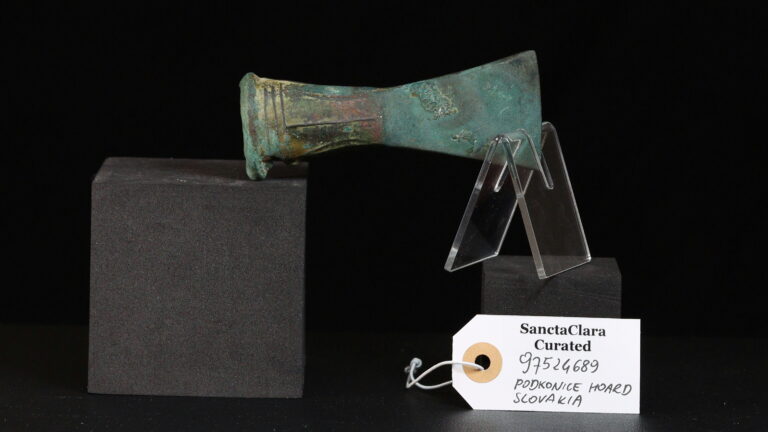
What makes the Carpathian tradition significant is not just the objects themselves but the evidence for organized, almost industrial-scale production. Mold hoards — caches of stone and clay bivalve molds — have been found across the region, indicating that metalworking was not an ad hoc activity but a structured craft with standardized products. The “Podkonice Hoard” socketed axe in the Sancta Clara Collection (Lot 97524689, Urnfield culture) comes from exactly this tradition of serial production, its form replicated across hundreds of examples found from the Danube to the Rhine.
The Pontic Steppe: Yamnaya, Catacomb, and Srubnaya Cultures
The vast grasslands stretching from the lower Danube to the Ural Mountains were home to a succession of semi-nomadic pastoralist cultures whose relationship with bronze was shaped by their mobile way of life. These steppe peoples did not build cities or leave monumental architecture, but their metalwork — compact, portable, and ruthlessly functional — spread across an enormous geographic range.
The Yamnaya horizon (c. 3300–2600 BC) is increasingly recognized as a pivotal force in European and Central Asian prehistory, both genetically and culturally. Yamnaya communities used arsenical copper for simple tools and weapons, but their real metallurgical legacy lies in the networks they established. The Yamnaya and their successors (the Catacomb culture, c. 2800–2200 BC, and later the Srubnaya or “Timber-Grave” culture, c. 1800–1200 BC) served as intermediaries between the metal-rich Caucasus and the copper-poor northern European plain.
Srubnaya bronzework is characterized by socketed celts, tanged knives, and distinctive hook-tanged spearheads. The steppe connection is visible in the Sancta Clara Collection’s Scythian arrowheads — the Scythians (c. 900–200 BC) were the cultural and, in part, biological descendants of these earlier steppe metallurgical traditions. The trilobate socketed arrowhead, mass-produced in standardized molds and carried by mounted archers across a territory stretching from the Black Sea to the Altai Mountains, represents the endpoint of two thousand years of Pontic steppe innovation. Lots 11481, 11482, 11486, and 11487 in the Collection document the formal variety within this seemingly simple weapon type — tanged and socketed, barbed and unbarbed, bilobate and trilobate — each variant reflecting specific tactical requirements.
The BMAC: Bronze of the Oxus Civilization
The Bactria-Margiana Archaeological Complex (BMAC, c. 2300–1700 BC), centered on the Amu Darya (Oxus) river basin in modern Turkmenistan, Uzbekistan, and northern Afghanistan, is one of the most important and least publicized Bronze Age civilizations. Its major sites — Gonur Depe, Togolok, Dashly, and Sapalli — reveal fortified settlements with monumental architecture, elaborate burial practices, and a distinctive metallurgical tradition.
BMAC bronzesmiths worked primarily in tin-bronze, exploiting the tin deposits of the Afghan highlands, and produced a range of objects that blurs the line between Mesopotamian, steppe, and Indus Valley traditions. Compartmented seals, miniature bronze columns, elaborate cosmetic containers, and “ritual axes” with animal-headed terminals are hallmarks of BMAC metalwork. The bronze shaft-hole axes from this region often feature decorative animal protomes — ibex, eagles, or serpents — that connect them aesthetically to the Luristan tradition further west.
The BMAC may have played a crucial intermediary role in tin distribution. The “tin route” from Afghan sources to Mesopotamian workshops almost certainly passed through BMAC territory, and some scholars have proposed that the BMAC cities functioned as entrepôts for this trade. The collapse of the BMAC around 1700 BC — possibly linked to shifts in the course of the Oxus — coincides with disruptions in the tin supply to Mesopotamia, underscoring the economic interdependence of these seemingly distant regions.
Luristan: The Master Bronzesmiths of Western Iran
No survey of Bronze Age metallurgy would be complete without extended attention to Luristan, and for the Sancta Clara Collection, this tradition is central. The Lorestan Province of western Iran produced a body of bronze work — spanning roughly 2600 to 600 BC — that is unmatched in its combination of technical virtuosity and aesthetic ambition.
Luristan bronzes encompass weapons (the long spearhead of Lot 84068495 at 456 mm, the leaf-shaped rat-tail tang spearhead of Lot 84058911 at 437 mm), tools, horse gear, and the so-called “standard finials” whose exact function remains debated. What distinguishes Luristan metalwork from that of neighboring Mesopotamia or Elam is its exuberant decorative vocabulary — “Master of Animals” compositions, heraldic ibex figures (as seen in the Collection’s Luristan ibex figurine, Lot 2248), and elaborate openwork that transforms functional objects into sculptural statements.
The technical range is equally impressive. Luristan smiths practiced lost-wax casting for complex three-dimensional forms, bivalve mold casting for weapons and tools, and extensive cold-working and annealing for sheet metal. The adze-axe head of Lot 84338037, with its decorated socket and carefully shaped blade, represents the high-water mark of Luristan tool production — a form that is simultaneously a weapon, a tool, and a prestige object.
The provenance challenges surrounding Luristan bronzes are well known. The vast majority entered the art market through uncontrolled excavation in the mid-twentieth century, and establishing specific findspots is often impossible. Nevertheless, the typological coherence of the material — and its distinctiveness from Mesopotamian, Elamite, and Central Asian metalwork — is beyond question.
China: From Majiayao to the Ritual Bronzes of the Shang and Zhou
The Chinese bronze tradition is in many ways the most technically accomplished in the ancient world, and it followed a trajectory entirely distinct from the Western Asian pattern.
The earliest copper objects in China appear in the Majiayao culture (c. 3300–2000 BC) of the upper Yellow River region — simple knives and awls of hammered copper. The Qijia culture (c. 2200–1600 BC) that followed produced the first true bronze objects in China, including knives, mirrors, and rings. Whether this metallurgical knowledge was independently developed or transmitted via steppe contacts from the BMAC or the Seima-Turbino phenomenon (see below) remains one of the great debates in Asian archaeology.
What is beyond debate is the radical transformation that occurred with the Erlitou culture (c. 1900–1500 BC) and the subsequent Shang dynasty. Chinese bronze-workers perfected the piece-mold technique — constructing complex multi-part ceramic molds rather than using the lost-wax method prevalent in the West — to produce ritual vessels of staggering complexity. The great Shang bronzes (ding tripods, gui food vessels, jue wine warmers) represent an entirely different relationship between metal and society. In the Near East, bronze was primarily the material of weapons and tools. In Shang China, the most ambitious bronze casting was directed at ritual vessels used in ancestor worship, and the possession of bronze vessel sets was the material foundation of political authority.
The scale of Shang bronze production was enormous. The single casting of a large fang ding vessel could require hundreds of kilograms of bronze and the coordinated labor of dozens of specialists. The tin came from mines in Yunnan and possibly Southeast Asia; the copper from deposits in the Yangtze valley and Jiangxi. The logistical infrastructure required to supply the Shang foundries was as impressive as the casting itself.
The Zhou dynasty (1046–256 BC) continued and transformed the Shang bronze tradition, introducing new vessel types, evolving decorative styles (from the fierce taotie masks of the Shang to the more abstract interlaced patterns of the middle and late Zhou), and eventually developing bronze coinage — a metallurgical application with world-historical consequences.
Southeast Asia: Ban Chiang, Dong Son, and the Southern Bronze
Southeast Asia’s bronze traditions have been the subject of fierce scholarly debate since the 1960s, when excavations at Ban Chiang in northeastern Thailand yielded bronze artifacts with early thermoluminescence dates that, if accurate, would have made the site contemporaneous with or even older than the earliest Near Eastern bronze. Subsequent re-dating has revised these claims downward — current consensus places Ban Chiang’s bronze phase at approximately 2000–1000 BC — but the site remains important as evidence that Southeast Asian metallurgy developed along an independent or semi-independent trajectory, possibly with input from Yunnan (southern China) rather than from the West.
The Dong Son culture (c. 1000 BC – 100 AD), centered in the Red River delta of northern Vietnam and extending into southern China, Cambodia, and the Indonesian archipelago, produced the most spectacular bronzes of Southeast Asia. The great Dong Son drums — massive cast-bronze kettle drums with elaborately decorated tympana showing boats, warriors, dancers, and geometric patterns — are among the most iconic objects of Southeast Asian antiquity. The Sancta Clara Collection includes a Dong Son bronze axe (Lot 98277415), a characteristic product of a culture that combined sophisticated lost-wax and piece-mold casting with a decorative vocabulary entirely distinct from either the Chinese or the Western Asian traditions.
The broader Southeast Asian bronze zone — encompassing the Mekong delta, the Khmer lands of modern Cambodia, and the islands of Indonesia — is increasingly understood as a network of interconnected metallurgical communities rather than a single cultural bloc. Bronze drums, axes, and ornaments found as far east as Papua New Guinea and as far south as Bali attest to the reach of these exchange networks.
The Seima-Turbino Phenomenon: Bronze Across the Eurasian Steppe
One of the most extraordinary episodes in the history of metallurgy is the Seima-Turbino phenomenon (c. 2100–1900 BC), named after cemetery sites in Russia’s Ural and Volga regions. Seima-Turbino metalwork — distinctive socketed spearheads, daggers, and celts of high-tin bronze, often decorated with animal figures — appears across a vast band of Eurasia from Finland to the Altai Mountains and possibly into China.
The speed of this spread and the technical sophistication of the objects have led some scholars to propose that Seima-Turbino represents the migration of specialist metalworking groups, possibly horse-mounted, who carried their technology (and their characteristic artifact types) across the steppe at a pace that would have been impossible for sedentary agricultural diffusion. Others see it as a cascade of technological transfer along existing exchange networks.
Whatever the mechanism, the Seima-Turbino phenomenon demonstrates that long before the Silk Road, the Eurasian steppe functioned as a conduit for technological innovation over continental distances. The tin-bronze alloys, the sophisticated socket casting, and possibly the horse-and-chariot complex all moved along this corridor.
The Great Lakes Old Copper Complex: Bronze Age North America?
The copper-working cultures of the Great Lakes region of North America (c. 5000–1000 BC) represent one of the oldest metalworking traditions in the world — and one of the most puzzling. The native copper deposits of Michigan’s Keweenaw Peninsula and Isle Royale provided raw material of exceptional purity, and the peoples of the Old Copper Complex produced a sophisticated range of objects: socketed spearheads, crescent-shaped knives, awls, fishhooks, beads, and bracelets.
What makes this tradition anomalous in the global history of metallurgy is that it remained a cold-working and annealing technology. Despite millennia of copper use, the Great Lakes metalworkers never developed smelting (the extraction of metal from ore), never discovered alloying (the deliberate addition of tin or arsenic to copper), and never adopted casting in molds. Each object was produced by hammering native copper nuggets — sometimes very large ones — into shape, with periodic annealing (heating and slow cooling) to relieve work-hardening.
This is not a failure of ingenuity. The Old Copper Complex artisans achieved remarkable results: socketed points with integrated tangs, thin-walled tubular beads, and large ceremonial blades. But the absence of smelting and alloying means that, technically, this tradition should not be classified as “Bronze Age” at all. It is, rather, a parallel and independent experiment in metallurgy — one that reached a natural ceiling imposed by the properties of pure copper and the absence of tin-bearing ores in the region.
The Old Copper Complex is important precisely because it illustrates that the path from native copper to smelted bronze was not inevitable. The Near Eastern and European sequences — native copper → smelted copper → arsenical bronze → tin-bronze — unfolded over millennia and required specific geological, economic, and social preconditions. Remove any one of those preconditions (abundant tin sources, long-distance trade networks, urban demand for harder alloys), and the progression stalls. The Great Lakes example reminds us that what we call “the Bronze Age” was a contingent historical development, not a predetermined stage of human evolution.
The Caucasus: The Forge Between Two Seas
The Caucasus region — the mountainous isthmus between the Black Sea and the Caspian — deserves its own entry in any survey of bronze metallurgy, because the evidence increasingly suggests that it was here, rather than in Mesopotamia proper, that some of the earliest systematic copper smelting and arsenical bronze production took place.
The Kura-Araxes culture (c. 3400–2000 BC) of the South Caucasus produced a distinctive suite of black-burnished pottery and simple copper-arsenic tools that spread from eastern Turkey to northern Iran. By the time of the Trialeti culture (c. 2200–1500 BC) in modern Georgia, Caucasian metalworkers were producing bronze weapons and vessels of extraordinary quality — including massive shaft-hole axes, finely proportioned spearheads, and gold-inlaid goblets that rank among the finest metalwork of the ancient world.
The large MBA split-socket pike in the Sancta Clara Collection (Lot 32737, 480 mm, 451 g) is attributed partly to the Transcaucasian / Trialeti tradition. Its robust proportions, rounded midrib, and ringed socket neck are consistent with a Caucasian origin, though the type also appears in the Levant, underscoring the interconnections between these metallurgical zones.
The Caucasus was also a major tin source — deposits in the Lesser Caucasus may have supplied bronze-working communities across the Near East — and the region’s role as a metallurgical crossroads, linking steppe, Anatolian, and Mesopotamian traditions, can hardly be overstated.
The European Atlantic and Urnfield Traditions
Western and Central Europe developed their own vigorous bronze traditions during the second and first millennia BC, largely independent of Near Eastern influence (though ultimately linked through long-distance tin and copper trade).
The Atlantic Bronze Age (c. 1300–700 BC), stretching from Iberia through western France, the British Isles, and into Scandinavia, is characterized by distinctive weapon and tool types — leaf-shaped swords, palstave axes, and elaborate gold ornaments — produced by communities connected by maritime exchange along the Atlantic seaboard.
The Urnfield culture (c. 1300–750 BC) of Central Europe, named for its cremation burial practice, represents the culmination of European Bronze Age metallurgy. Urnfield smiths produced the first true slashing swords (as opposed to the earlier thrusting rapiers), socketed axes of standardized form, and elaborate sheet-bronze armor and vessels. The large socketed spearhead of Lot 97137769 in the Sancta Clara Collection — 29.5 cm long, 340 g, with a pronounced midrib and wide shaft socket — is a classic Urnfield product, its bivalve-mold casting seam still visible at the socket neck.
The Urnfield period also saw the emergence of large-scale bronze hoarding — deliberate deposits of bronze objects, sometimes hundreds of pieces, buried in pits or rivers. Whether these represent votive offerings, metalworkers’ stock, or emergency caches remains debated, but they provide an extraordinary window into the volume of bronze in circulation during this period.
The Levant and Ugarit: Where Trade Routes Converged
The eastern Mediterranean coast — modern Syria, Lebanon, Israel, and Jordan — was the great crossroads of Bronze Age metallurgy. Here, Egyptian, Mesopotamian, Anatolian, Aegean, and Cypriot traditions met, mingled, and produced hybrid forms.
The port city of Ugarit (modern Ras Shamra in Syria, c. 1450–1185 BC) was a node in this exchange network. The “poche aux bronzes” at Ugarit — a cache of bronze weapons discovered by Claude Schaeffer in the early 1960s — included socketed spearheads that combine Near Eastern socket construction with Aegean blade morphology. The Sancta Clara Collection’s socketed spearhead from Ugarit (Lot 90939651) belongs to this milieu: its leaf-shaped blade, folded-sheet socket with visible seam, and triple-rivet attachment are hallmarks of the Levantine coastal tradition.
Cyprus, the great copper island (the very word “copper” may derive from the Latin cuprum, itself from the Greek Kyprios, “of Cyprus”), was the indispensable raw-material supplier for much of the eastern Mediterranean Bronze Age. Cypriot oxhide ingots — standardized copper slabs shaped like stretched animal hides — have been found in shipwrecks and port cities from Sardinia to the Euphrates. The Cypriot spearhead with rat-tail tang (Lot 83118347, c. 2400–2100 BC) in the Collection represents an early phase of this island’s metallurgical output, before the great expansion of Late Bronze Age copper production.
Sub-Saharan Africa: Independent Invention and the Iron Leap
Sub-Saharan Africa’s metallurgical history complicates the conventional sequence. In much of the continent, copper and iron smelting appear nearly simultaneously — or, in some regions, iron precedes copper. The Nok culture (c. 1500 BC – 500 AD) of modern Nigeria was smelting iron by at least 900 BC, and copper smelting in the Aïr Massif of Niger is dated to the mid-second millennium BC.
The copper mines of the Copperbelt (modern Zambia and the Democratic Republic of Congo), though best known for industrial-era extraction, were exploited in antiquity for copper smelting, and the “lost-wax” casting traditions of West Africa — most famously the Benin Bronzes, though these are considerably later — represent a technically independent development of bronze casting that owes nothing to Near Eastern or European precursors.
Africa’s metallurgical independence is a corrective to the diffusionist models that once dominated the field. The continent’s metalworkers were not passive recipients of technology from the north; they were innovators who developed smelting, alloying, and casting techniques suited to their own ores, fuels, and cultural requirements.
The Japanese Archipelago: Yayoi and the Bronze Bells
Japan’s Bronze Age (the Yayoi period, c. 900 BC – 300 AD) arrived through the Korean Peninsula, bringing rice agriculture and bronze metallurgy in a single cultural package. The most distinctive products of Yayoi bronze-working are dōtaku — large, thin-walled bronze bells decorated with flowing water, animals, and scenes of daily life. These bells are almost certainly ritual objects rather than musical instruments (their walls are too thin to survive regular use as bells), and they have no clear parallels elsewhere in East Asia.
Yayoi bronze-workers also produced weapons — swords and halberds — that closely follow Korean and, ultimately, Chinese prototypes. But the dōtaku represent a genuinely original Japanese contribution to bronze metallurgy, one that underscores how quickly imported technology can be adapted to serve local cultural needs.
Conclusion: Bronze as a Mirror of Civilization
What strikes me most, after years of studying and handling artifacts from these disparate traditions, is how powerfully a bronze object encodes the society that made it. A Luristan spearhead and an Urnfield socketed axe are both “bronzes,” but they belong to utterly different worlds — different ores, different alloy recipes, different casting technologies, different conceptions of what a weapon should be and do. The Dong Son drum and the Shang ding vessel are both products of sophisticated piece-mold casting, but they served entirely different ritual and social functions.
The Sancta Clara Collection, though centered on the ancient Near East and the Mediterranean, contains echoes of many of these traditions — from the Chalcolithic Balkans (the Old Europe axe-adze of Lot 43951422) to the Dong Son world of Southeast Asia (Lot 98277415), from the earliest Cypriot copper (Lot 83118347) to the final flourishing of Urnfield Europe (Lot 97524689). Each artifact is a point on a network that, at its greatest extent, linked the tin mines of Cornwall to the copper deposits of Yunnan across half the circumference of the earth.
That network, fragile and contingent as it was, made the Bronze Age the first truly interconnected era of human history. Iron would eventually replace bronze — harder, cheaper, and made from ores available nearly everywhere — but the world that bronze created, a world of long-distance trade, specialist craft production, and complex political organization, did not disappear. It merely changed its material foundation. The bronze endures — green with age, heavy in the hand, still carrying the mark of the smith who cast it three or four thousand years ago.