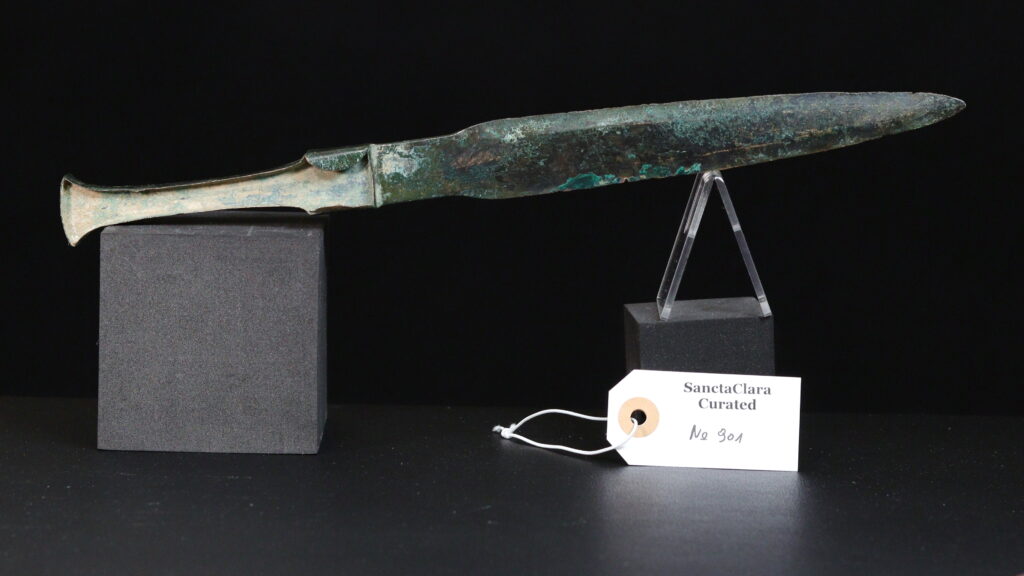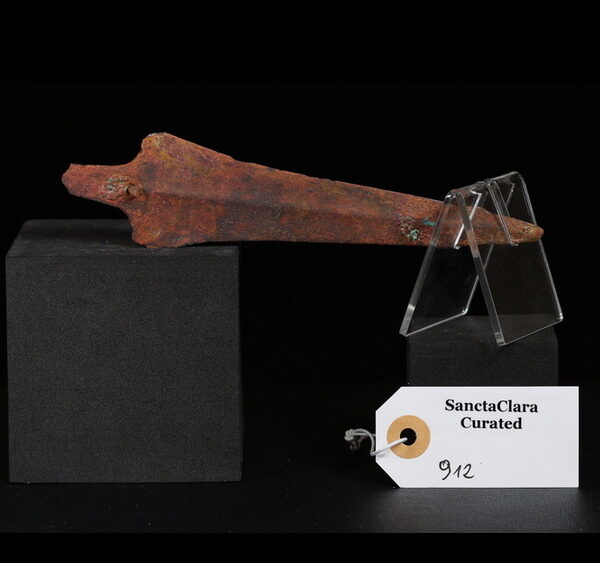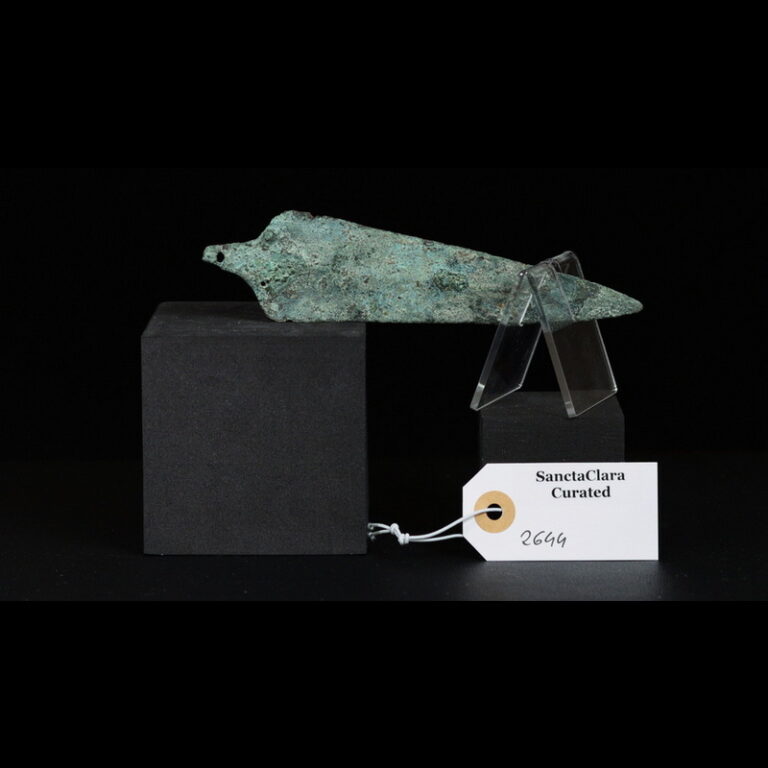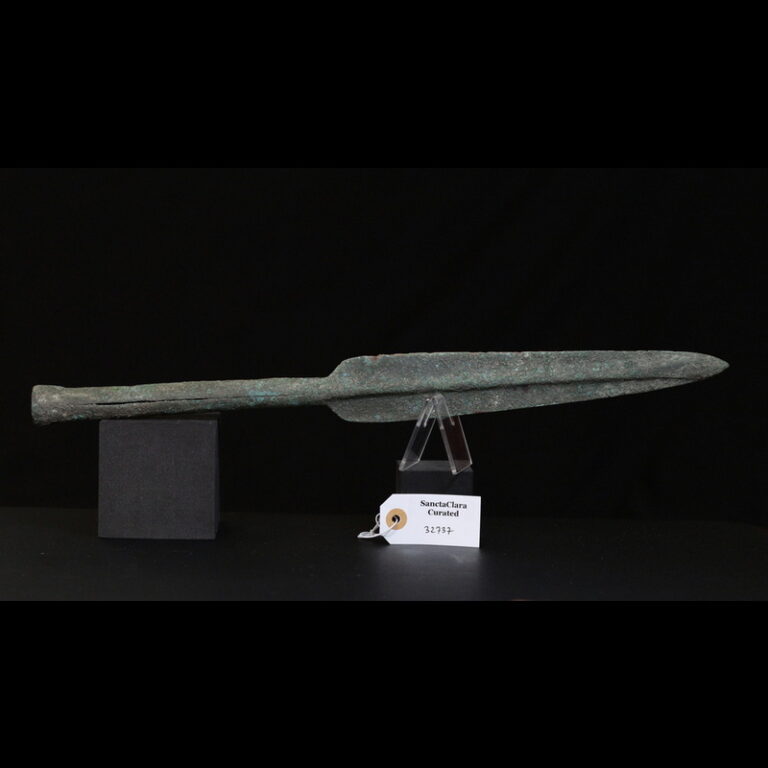
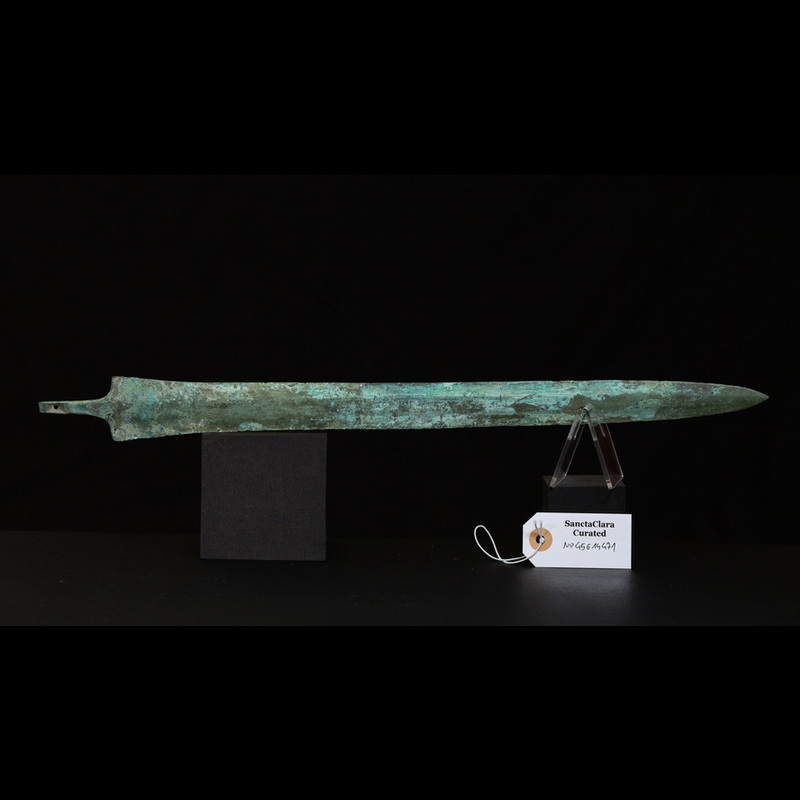

The transition from early copper daggers to the formidable longswords of the Late Bronze Age is a fascinating study in ancient engineering. The core challenge for ancient bronzesmiths wasn’t just casting a long blade; it was solving the “hafting problem.” A sword acts as a lever, and the point where the blade meets the handle (the hilt) is subjected to massive sheer forces upon impact. If the mount is weak, the weapon shatters or disassembles in the user’s hand.
Here is an in-depth look at how Bronze Age craftsmen solved this problem, step by step.
I. The Genesis: Tang-less Blades and Organic Binders
In the Chalcolithic and Early Bronze Age, the concept of a longsword did not yet exist. Weapons were primarily daggers or short dirks. The mounting techniques were essentially carry-overs from how flint daggers were hafted.
These early blades were tangless—meaning the base of the blade was simply flat or slightly rounded.
The Mounting Process: The base of the bronze blade was slotted into a deep, precisely carved notch in the wooden or bone handle.
The Binders: Because there was no mechanical interlock (like a pin or rivet), craftsmen relied entirely on chemical and physical binders. They used bone glue, birch bark tar, or pine pitch to cement the blade into the slot. Once seated, the outside of the hilt was tightly wrapped with wet sinew, leather strips, or plant fibers. As the sinew dried, it shrank, creating a vice-like grip on the base of the blade.
Limitations: While highly effective for thrusting (where the force pushes the blade back into the handle), this mount was disastrous for slashing or parrying. Lateral forces would easily crack the glue and snap the organic bindings.
II. The First Mechanical Step: The Short Tang
As metallurgy improved and blades grew slightly longer, the limits of the tangless mount became obvious. The first structural innovation was the short tang.
Instead of a flat base, the mold was altered to cast a small, narrow projection of metal at the very bottom of the blade.
The Mount: This short tang was inserted into a corresponding hole bored down into the grip.
Function: While still heavily reliant on glues and tightly bound sinew to keep the weapon together, the short tang provided crucial lateral stability. It acted as an internal spine, preventing the blade from twisting out of the hilt when the weapon struck a target at an angle.
III. The Revolution of Rivets and the Wide Hilt Guard
The true leap toward the modern sword occurred in the Middle Bronze Age with the widespread adoption of rivets. This allowed weapons to transition from short thrusting dirks to longer, more versatile swords capable of light slashing.
The Wide Hilt Guard (Shoulders): Smiths began casting blades with wide, flared bases (often trapezoidal or semi-circular). This wide metal base sat completely outside the wooden grip, acting as a guard. This prevented the blade from being driven back into the user’s hand during a heavy thrust.
The Rivet System: Through this wide metal base, craftsmen punched or cast several small holes. A hilt—usually carved in two halves or featuring a deep slot—was fitted over the base. Bronze pins (rivets) were then driven through the wood, through the holes in the bronze blade, and out the other side of the wood, where they were hammered flat to lock everything in place.
Evolution of Rivets: Early models might have two simple rivets. As swords grew to 60cm or more, hilts became more complex, sometimes featuring an arched base with four, six, or even eight rivets distributed across the “heel” of the blade.
IV. The Ultimate Solution: The Full Tang (Flange-Hilted Swords)
The pinnacle of Bronze Age weapon design arrived in the Late Bronze Age (roughly 1200 BCE) with weapons like the famous Naue II type sword. These weapons were designed for heavy, devastating slashing as well as thrusting.
The Anatomy of the Full Tang: Instead of a short tab or a wide base, the metal of the blade continued seamlessly to form the complete length and shape of the handle, ending at the pommel.
Flanges: To secure the grip, the edges of this metal handle were raised to form “flanges” (like a shallow, metal trough).
The Mount: Organic grip plates were carved to fit perfectly inside these flanged channels. They were then secured using multiple rivets passing entirely through the metal tang. Even if the rivets loosened slightly, the raised metal flanges prevented the organic grip plates from shifting.
Variations: Some late full-tang swords relied entirely on the tight friction-fit of the flanges and heavy wrapping, omitting rivets entirely to avoid creating weak points (drill holes) in the metal tang.
V. The Canvas of the Craftsman: Organic Hilt Materials
The metal survives in the archaeological record, but the hilts often decay. However, surviving fragments in waterlogged or extremely arid environments show us that Bronze Age warriors had access to a rich variety of materials, chosen for durability, grip, and status.
Wood: The most common material. Hardwoods like ash, oak, and boxwood were preferred for their resistance to splitting and impact shock.
Bone and Antler: Highly prized for their durability and the ease with which they could be carved with intricate geometric patterns. Antler (specifically red deer) is incredibly tough and absorbs shock beautifully.
Horn: Animal horn could be boiled, softened, and pressed onto a tang. As it cooled, it shrank and hardened, creating a custom, rock-solid fit.
Ivory: Found on elite, high-status weapons (such as those from Mycenaean shaft graves), imported ivory from hippopotamus or elephant tusks signaled massive wealth.
Decorations: These organic bases were rarely left plain. Elite weapons were often studded with amber pommels, wrapped in gold wire for better grip, or inlaid with contrasting woods and metals.