
At the point of an arrow
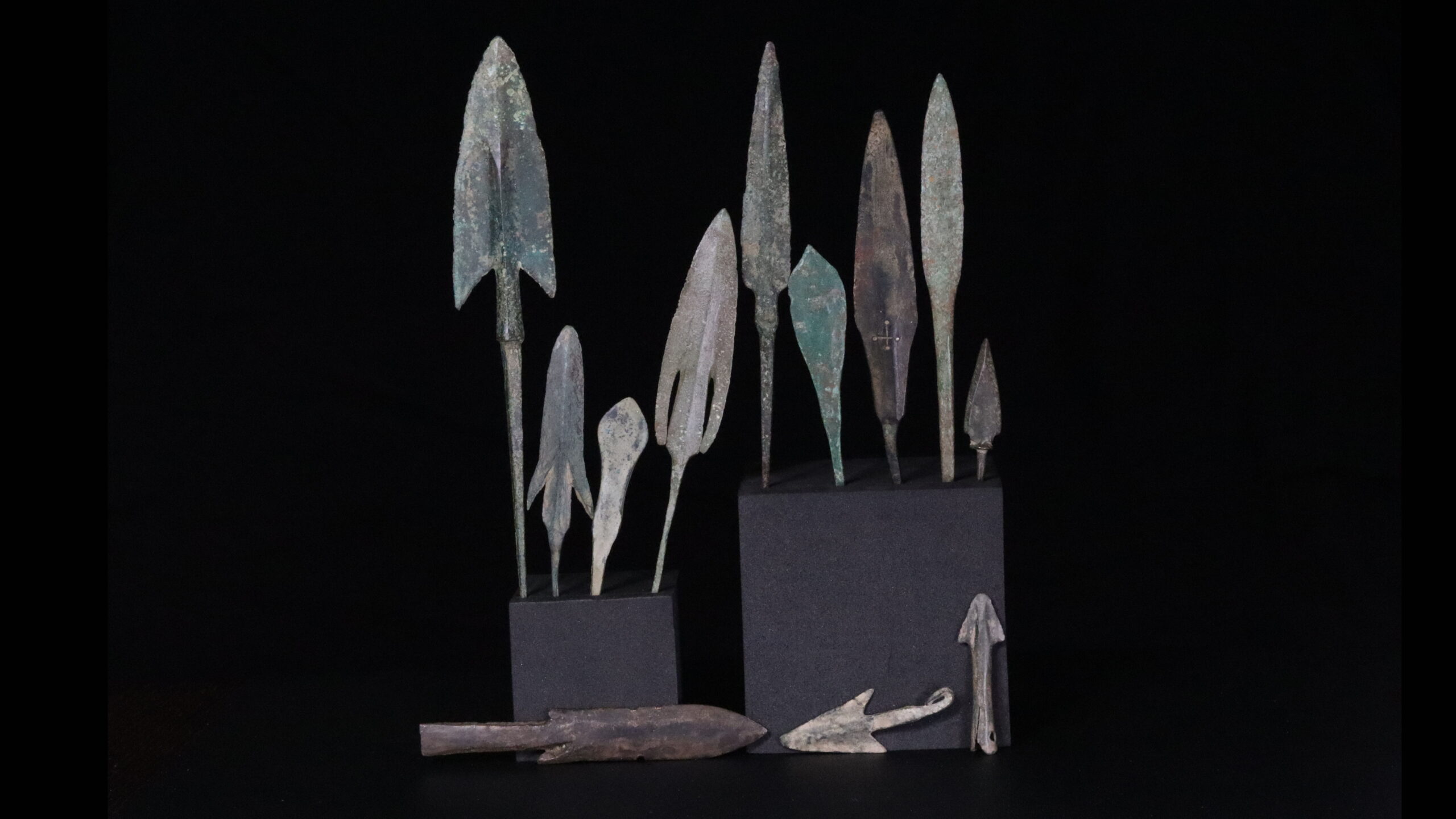
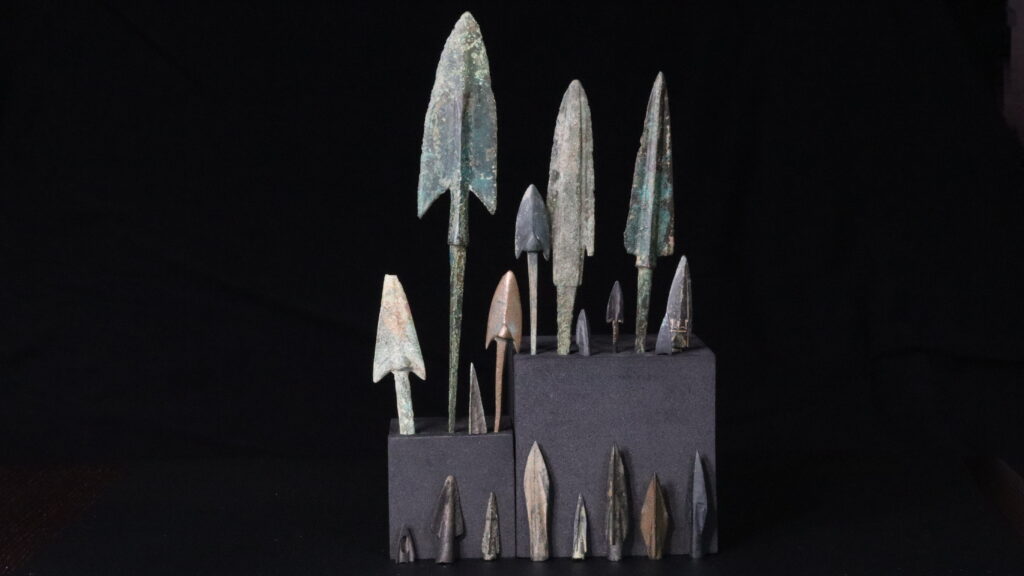
Of all the categories of ancient bronze artifacts, arrowheads present the greatest challenge to the classifier — and the greatest reward to the careful observer. No other class of object displays such extraordinary diversity of form within such a compact physical package. The Sancta Clara Collection contains arrowheads ranging from massive Elamite bilobate points exceeding 140 millimetres in length to compact Scythian trilobate heads barely 18 millimetres from tip to socket base. Between these extremes lies a universe of variation in blade shape, cross-section, mounting method, barb configuration, and surface treatment that reflects thousands of years of experimentation, adaptation, and — above all — the evolving demands of warfare.
This article offers a systematic guide to the typology of ancient metal arrowheads, drawing on the corpus of the collection and on the broader archaeological record. It examines how arrowheads are classified, why certain forms developed where and when they did, and what each design choice tells us about the people who made and used these small but consequential objects.
The Fundamentals: How Arrowheads Are Classified
Any typological system for ancient arrowheads must account for several independent variables simultaneously. No single characteristic is sufficient to classify a point; rather, it is the combination of features that defines a type and places it within a cultural and chronological framework. The principal axes of classification are mounting method, blade configuration, blade geometry, cross-section, and the presence or absence of barbs and spurs.
Mounting Method: Tanged versus Socketed
The most fundamental division in arrowhead typology is between tanged and socketed mounting.
A tanged arrowhead has a narrow extension — the tang — projecting from the base of the blade. The tang is inserted into a slot or socket cut into the end of the arrow shaft, then secured by binding, adhesive, or a combination of both. Tangs may be flat (rectangular in cross-section), round, or square, and they may terminate in a simple taper, a flattened end, or a hooked curl (the “rat-tail” tang familiar from spearhead typology).
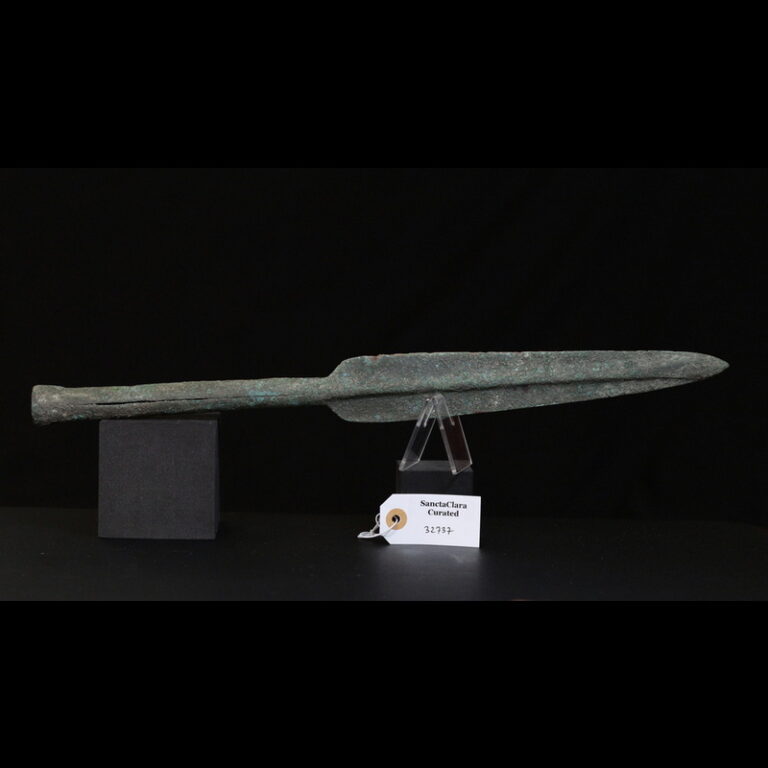
A socketed arrowhead has a hollow cone or tube at its base into which the end of the arrow shaft is inserted. The shaft fits inside the arrowhead rather than the arrowhead fitting inside the shaft. Sockets may be round or slightly conical, and they frequently feature a small hole — the rivet hole — through which a pin or peg was driven to prevent the point from separating from the shaft on impact.
This distinction is not merely a matter of manufacturing preference. It reflects a deep relationship between projectile design and the materials available for arrow shafts in different environments.
Tanged points and reed shafts. In the arid and semi-arid regions of the Near East, North Africa, and the Mediterranean — Egypt, Mesopotamia, the Levant, Elam, and the broader Iranian Plateau — the most readily available material for arrow shafts was reed: Phragmites australis and related species that grew densely along rivers, canals, and marshes. Reed shafts are hollow. A tang fits naturally into the hollow interior of a cut reed, where it can be glued with bitumen or resin and bound with sinew. A socket, conversely, would require the reed to be inserted into the arrowhead, which is mechanically awkward with a hollow, compressible reed shaft. The dominance of tanged arrowheads across the ancient Near East from the third millennium through the first millennium BC reflects this practical reality.
Socketed points and wood shafts. In the forests and steppes of the Caucasus, Central Asia, the Pontic region, and northern and central Europe, solid wooden shafts — typically of birch, ash, hazel, or pine — were the standard. A solid wooden shaft cannot easily accept a tang driven into its end grain without splitting; but it fits neatly into a socket, where the metal collar grips the wood circumferentially and the rivet pin provides mechanical security. The socketed arrowhead tradition that developed among the Scythians, Cimmerians, and other steppe peoples, and which subsequently spread across the ancient world, is inseparable from the wooden shaft technology of the northern forests and grasslands.
When socketed Scythian-type points entered the Near East — through trade, warfare, and the migration of mounted archer peoples beginning in the seventh century BC — they represented not just a new arrowhead form but an entirely different approach to the arrow as a system. The adoption of socketed points in regions that traditionally used reed shafts required either the parallel adoption of wooden shafts or the development of hybrid mounting solutions, such as inserting a solid wooden foreshaft into the hollow reed to create a composite shaft that could accept a socket.
Blade Configuration: Bilobate, Trilobate, and Full-Bodied
The second major classification axis is blade configuration — the number and arrangement of cutting edges or blades on the arrowhead.
Bilobate (two-bladed) arrowheads have two flat or slightly curved blades extending symmetrically from a central axis, creating a form that is lenticular, rhombic, or leaf-shaped in cross-section. This is the oldest and most widespread configuration for metal arrowheads. Bilobate points can be produced with relative simplicity — a flat bilobate head can be hammered from sheet metal, and cast bilobate heads require only a straightforward two-piece mould. The central axis between the two blades typically features a raised midrib or medial ridge that provides structural stiffness.
The bilobate form dominated arrowhead production across the ancient Near East, Egypt, and the Mediterranean from the earliest copper arrowheads of the third millennium BC through the Iron Age. Tanged bilobate points with flat, leaf-shaped or deltoid blades are among the most common arrowhead finds from Bronze Age Mesopotamia, Elam, and Egypt. Socketed bilobate points, introduced from the Pontic steppe region, became widespread from the seventh century BC onward.
Trilobate (three-bladed) arrowheads have three blades arranged at 120-degree intervals around a central axis, creating a trefoil or three-pointed-star cross-section. This configuration represents a significant advance in both manufacturing complexity and terminal ballistics. A trilobate point creates three cutting channels as it enters a target, producing a wound that is far more difficult to close than the single slit left by a bilobate point. It is also structurally stronger against lateral bending than a bilobate form of equivalent mass — the three blades brace each other, much as a triangular truss is stronger than a flat beam.
The trilobate arrowhead first appears in the archaeological record of the Pontic steppe and the Caucasus, where it is associated with the Cimmerians and early Scythians. It entered the Near East around the mid-seventh century BC, carried southward by mounted archer peoples, and was rapidly adopted by the Assyrians, Babylonians, and Persians. By the sixth century BC, socketed trilobate points had spread across the Mediterranean and into Central Europe. The type persisted through the Hellenistic and Roman periods, eventually becoming the dominant arrowhead form across much of Eurasia.
Manufacturing a trilobate point requires either a more complex mould (typically a three-piece mould or a lost-wax casting) or, in iron, the challenging process of forging three symmetrical blades from a single piece of metal. The additional cost in material and labour was evidently justified by superior battlefield performance — a fact confirmed by recent experimental archaeology, which has demonstrated that trilobate points offer significant advantages over bilobate forms when penetrating layered armour and leather.
Full-bodied (pyramidal and conical) arrowheads are solid three-dimensional forms — triangular pyramids, square pyramids, or cones — without distinct blade edges. These points rely on concentrated impact force rather than cutting action to penetrate a target. In cross-section, they are triangular, square, or circular. Full-bodied points are heavier than equivalent-sized bladed points, giving them greater kinetic energy at shorter ranges, and their compact geometry makes them highly effective against armour.
The smallest Scythian arrowheads in the collection — compact triangular pyramids barely 18 to 25 millimetres long — are full-bodied points optimised for massed volley fire from composite bows. Their diminutive size is not a sign of crudeness; it is a design choice reflecting the Scythian preference for light, fast arrows that could be carried in large quantities (thirty or more to a quiver) and fired rapidly from horseback. What these points lacked in individual destructive power they compensated for in volume and velocity.
Blade Geometry: Lanceolate, Deltoid, Rhombic, Leaf-Shaped, and Bodkin
Within each blade configuration, arrowheads exhibit a range of blade geometries — the outline shape of the blade as viewed from the flat side.
Lanceolate blades are narrow and elongated, tapering gradually from a maximum width near the midpoint to a sharp point at the tip and a narrower base at the tang or socket. This is one of the most common geometries across all periods and regions, appearing on everything from Elamite tanged bilobate points to Greek socketed bilobate heads.
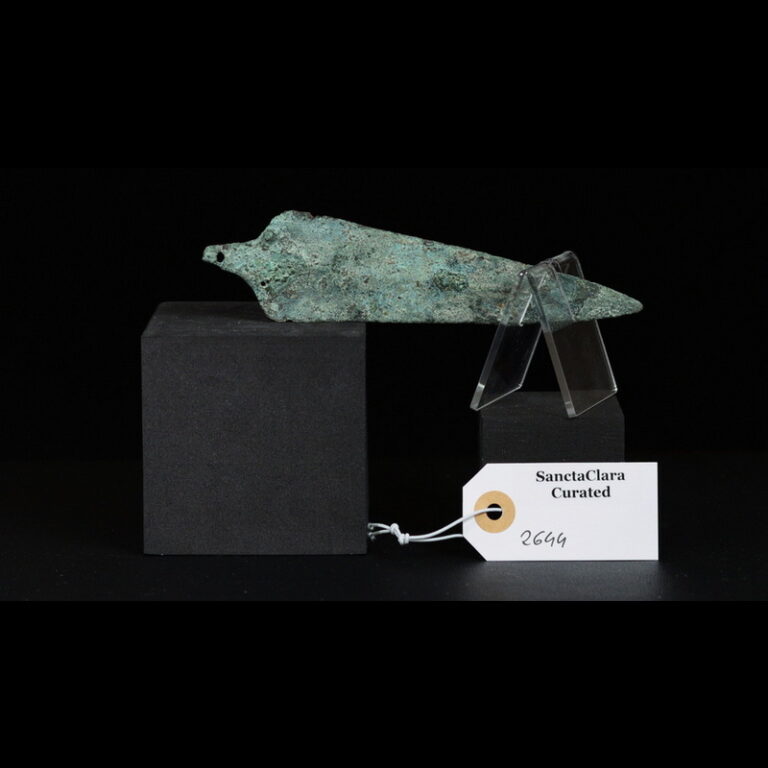
Deltoid (triangular) blades have a broad base and straight or slightly convex edges converging to a point, creating a roughly equilateral or isosceles triangle. Deltoid points are common among early Mesopotamian and Elamite tanged arrowheads, where they were often hammered from flat sheet metal. The broad base provides maximum cutting width, making these points effective against unarmoured targets.
Rhombic (diamond-shaped) blades have their maximum width at or near the midpoint, with edges converging to points at both tip and base. This geometry provides good penetration (the narrow tip concentrates force) while still delivering a wide cutting channel through tissue. Many tanged bilobate points from the Persian and Hellenistic periods exhibit rhombic blade geometry.
Leaf-shaped blades are a subset of lanceolate forms with more pronounced curvature — the edges swell outward from the base, reach maximum width in the upper third of the blade, and converge to a point. Leaf-shaped blades are characteristic of Egyptian and Cypriot bilobate arrowheads.
Bodkin points are narrow, spike-like forms with minimal blade width — essentially elongated pyramids or cones. They are designed exclusively for armour penetration. The bodkin concentrates the arrow’s kinetic energy on the smallest possible area, maximising the pressure applied to the target surface. Bodkin points sacrifice cutting action entirely in favour of punching through rigid defences. They appear in iron from the late first millennium BC onward but have antecedents in narrow bronze points from earlier periods.
Cross-Section: Flat, Ribbed, Triangular, and Square
The cross-sectional profile of an arrowhead — the shape revealed if the blade were sliced perpendicular to its long axis — is a critical typological feature with direct functional implications.
Flat-bladed points have a simple flat cross-section, sometimes with a slight thickening along the centreline. These are the earliest and simplest metal arrowheads, often produced by hammering from sheet copper or bronze. Flat blades offer maximum cutting width for minimum material but are structurally weak — they bend easily on impact with bone or armour.
Rib-bladed points have a raised midrib running along the central axis of each blade, creating a lenticular or diamond-shaped cross-section. The midrib dramatically increases the structural rigidity of the blade without significantly increasing its weight. Ribbed bilobate points are among the most common arrowhead forms in the Bronze Age Near East, and the midrib is a nearly universal feature of well-made tanged arrowheads from Elam, Luristan, and Mesopotamia.
Triangular cross-section refers to the profile of trilobate points, where three blades create a solid or semi-hollow triangle (or trefoil). The triangular cross-section provides excellent structural integrity and creates a wound channel that resists closure.
Square cross-section is found on full-bodied pyramidal points, where four flat faces meet at sharp edges. Square-section bodkin points are particularly effective against plate armour and mail, as the edges can catch and part the rings of chainmail more effectively than a round-section point.
Barbs, Spurs, and Knobs
Many ancient arrowheads feature auxiliary projections — barbs, spurs, or knobs — that serve distinct tactical purposes.
Barbs are rearward-projecting extensions of the blade edges at the widest point of the arrowhead. Barbed arrowheads are designed to resist extraction: once embedded in flesh, the barbs catch on tissue and muscle fibres, making it impossible to pull the arrow out without causing further damage. Barbed points are anti-personnel weapons intended for use against unarmoured or lightly armoured targets, where the goal is to maximise wound severity.
Spurs are small projections extending rearward from the base of the blade, below the socket or at the junction of blade and socket. Unlike barbs, which are part of the blade itself, spurs are separate structural elements. Their primary function is debated: they may serve as anti-withdrawal barbs, as stabilising fins that improve flight characteristics, or as stops that prevent the arrow from penetrating too deeply (ensuring the shaft remains visible and can be located for salvage). Many socketed bilobate and trilobate points from Scythian, Assyrian, and Greek contexts feature single or paired spurs.
Knobs are rounded swellings at the junction of the blade and the tang, found primarily on Egyptian and Levantine bilobate tanged arrowheads. The knob serves as a stop against the shaft end, preventing the arrowhead from being driven too deeply into the shaft, and provides a wider contact surface for binding.
Blade Width, Target, and Tactical Purpose
The width of an arrowhead blade is not arbitrary. It reflects a calculated balance between cutting power and penetration — a balance dictated by the nature of the intended target.
Wide-bladed arrowheads — those with broad leaf-shaped, deltoid, or barbed bilobate blades — are designed for use against unarmoured or lightly armoured targets: flesh, hide, and textile. A wide blade creates a large wound channel, maximises blood loss, and causes maximum tissue disruption. Against an unprotected human or animal target, a wide-bladed point is devastating. But that same width increases drag and reduces penetration when the point encounters hard resistance — bone, scale armour, or leather.
Narrow-bladed arrowheads — lanceolate bilobate points with slim profiles, trilobate points, and bodkin-style pyramids — are designed to defeat armour. A narrow point concentrates force on a smaller area, generating higher pressure that can punch through leather, linen corselet, or scale. The sacrifice is a smaller wound channel: a narrow point that penetrates armour may do less tissue damage than a wider point striking bare flesh.
Ancient armies used both types, and the archaeological evidence — particularly from sites where quiver contents or magazine stores have been found intact — shows that warriors frequently carried mixed arsenals. The Neo-Assyrian military, for example, deployed both wide bilobate and narrow trilobate arrowheads, presumably selecting point type based on the anticipated level of enemy armour. This is not fundamentally different from the practice of later medieval archers, who carried broadheads for use against horses and unarmoured infantry and bodkin points for use against mailed knights.
The evolution of arrowhead design through the first millennium BC can be read, in part, as an arms race between projectile technology and body armour. As leather and bronze scale armour became more common on Near Eastern and Mediterranean battlefields, arrowhead design shifted toward narrower, more penetrating forms. The trilobate socketed point — optimised for defeating leather armour while still creating a significant wound — was a direct product of this arms race.
Manufacturing: Casting, Forging, and Finishing
Bronze Arrowheads: The Economics of Casting
The great advantage of bronze for arrowhead production was its suitability for casting. Bronze melts at approximately 950°C (accessible with a bellows-driven charcoal furnace), flows well in moulds, and reproduces fine detail with excellent fidelity. These properties made bronze ideal for mass production of small, standardised objects — and arrowheads are, above all, objects that must be produced in quantity.
Simple flat-bladed arrowheads — particularly the early tanged bilobate forms of the Near East — could be produced by cutting and hammering flat bronze sheet, but the majority of bronze arrowheads from the mid-second millennium BC onward were cast.
Bilobate points were typically cast in two-piece stone moulds. Each half of the mould contained the impression of one face of the arrowhead; when clamped together, the two halves formed the complete shape. Molten bronze was poured through a sprue hole and allowed to solidify. After casting, the arrowhead was removed, the casting flash (excess metal along the mould seam) was trimmed, and the edges were sharpened by grinding or filing. A single stone mould could produce hundreds or thousands of identical points over its lifetime.
Trilobate points required more complex moulds — typically three-piece moulds or, for the finest examples, the lost-wax process. The British Museum holds a copper alloy mould (BM 124624) designed to simultaneously cast two trilobate and one bilobate socketed arrowhead, offering a vivid illustration of how mass production worked in an ancient foundry. Despite the higher mould complexity, the process remained fundamentally one of pouring and replicating — each mould cycle producing multiple identical points.
After casting, bronze arrowheads were finished by filing or grinding to sharpen the blade edges and smooth the surface. On many arrowheads in the collection, fine file marks are visible under magnification along the blade edges — the signature of this finishing process. Some points show evidence of additional cold-working: light hammering of the blade edges to work-harden them and improve edge retention.
The economics of cast bronze arrowhead production were compelling. A skilled foundry worker with good moulds, an assistant to work the bellows, and a supply of charcoal and bronze ingots could produce dozens of arrowheads per day. This is military logistics on an industrial scale — and the enormous quantities of arrowheads found at siege sites and battlefield deposits across the ancient Near East testify to production volumes that are impressive even by modern standards.
Early Copper and Arsenical Bronze Arrowheads
The earliest metal arrowheads were not cast but hammered from native copper or early arsenical copper — the same material and technique used for the first metal daggers, chisels, and flat axes. These proto-arrowheads, dating from roughly 3500 to 2000 BC, are flat, simple in outline (typically leaf-shaped or deltoid), and often crude by later standards.
Hammered copper arrowheads from Ur, Susa, and other early Mesopotamian and Elamite sites are identifiable by their irregular edges, uneven thickness, and the absence of the crisp detail that casting produces. Many were literally cut from flat copper sheet with a chisel and then hammered to rough shape. Tangs were formed by narrowing one end of the sheet, sometimes with a slight curl or hook at the terminus.
The transition from hammered copper to cast arsenical bronze — and subsequently to cast tin bronze — transformed arrowhead production from a craft activity producing individual pieces to a proto-industrial process producing standardised output. This transition is visible in the archaeological record as a shift from unique, variable arrowheads to populations of nearly identical points, clearly produced from the same moulds.
Iron Arrowheads: The Return to Individual Production
The transition from bronze to iron arrowheads reversed the manufacturing advantages that casting had provided. Iron could not be cast using the technology available in the ancient world — its melting point (approximately 1538°C) was beyond the reach of early furnaces, which could produce only a spongy, slag-filled bloom of wrought iron that had to be consolidated by repeated heating and hammering.
Each iron arrowhead therefore had to be individually forged. A blacksmith would take a small piece of iron bar stock, heat it in a forge, and hammer it to shape on an anvil — forming the tang or socket, drawing out the blade, and creating the point. For bilobate forms, this was relatively straightforward. For trilobate forms, the process was vastly more demanding: the smith had to forge three symmetrical blades from a single piece of metal, a task requiring considerable skill and producing significant variation between individual points.
The consequence was a dramatic reduction in production rate and an increase in per-unit cost. Where a bronze foundry could produce dozens of identical arrowheads per day, an iron smith forging individual points might manage only a handful. This had strategic implications: iron arrowheads were more expensive, less standardised, and available in smaller quantities than their bronze predecessors. It is no coincidence that bronze casting continued to supply arrowheads for centuries after iron had replaced bronze for swords, spearheads, and tools. The economics of mass production favoured bronze for arrowheads long after iron had proven its superiority for larger weapons.
Despite the significantly greater challenge of hand-forging trilobate blades from iron relative to bilobate forms, tanged iron trilobate points were nevertheless produced, demonstrating that the tactical advantages of the trilobate form were considered worth the manufacturing premium. Iron skeuomorphs of northern socketed bronze arrowheads have been found at sites like Hasanlu and Karmir-Blur, illustrating the transition period during which iron smiths reproduced familiar bronze forms in the new material.
The Problem of Provenance: Migration, Trade, and Misattribution
One of the most persistent difficulties in arrowhead studies is the attribution of specific arrowhead types to specific cultures or regions. The temptation is strong: Scythian-looking trilobate points should indicate Scythian presence; Assyrian-style barbed bilobate points should mark Assyrian military activity; Egyptian knobbed bilobate points should signal Egyptian involvement. But the reality is far more complicated.
Arrowheads travel. They travel in quivers carried by soldiers who march thousands of kilometres on campaign. They travel as trade goods exchanged between cultures with radically different arrowhead traditions. They travel as diplomatic gifts, as war trophies, and as scavenged battlefield salvage. A Scythian trilobate point found at an Assyrian destruction level might represent a Scythian attack — or it might represent an Assyrian archer who adopted Scythian-type points, or a Scythian mercenary serving in the Assyrian army, or a Scythian point traded through intermediaries and used by someone with no Scythian connection whatever.
The archaeological literature is full of cautionary examples. The same arrowhead type has been identified in different publications as twelfth-century Mongol, eighth-century Avar, fourth-century Sarmatian, and second-century Roman — all attributions based on assumed cultural associations rather than contextual evidence. The British Museum’s Portable Antiquities Scheme database records Graeco-Scythian bilobate arrowheads, an Achaemenid Persian trilobate arrowhead, and a Parthian triblade arrowhead — all found in Britain, thousands of kilometres from their regions of origin.
The spread of trilobate arrowheads across Eurasia offers a particularly instructive case. The type originated on the Pontic steppe, entered the Near East through Cimmerian and Scythian incursions in the seventh century BC, was adopted by the Assyrians and Babylonians, spread to the Persians under the Achaemenids, passed to the Greeks through Persian contact, and eventually reached the Roman military through eastern auxiliary archer units. By the third century AD, iron trilobate points had become the most common arrowhead type in the Roman army — a form invented by Central Asian horse archers being manufactured in Roman workshops for use across an empire stretching from Britain to Mesopotamia. Attributing a trilobate point to “the Scythians” based on morphology alone is therefore meaningless without supporting contextual evidence.
For the collector and the cataloguer, this means that typological identification and cultural attribution are two separate operations. We can say with confidence what type an arrowhead is. Saying who made it, where, and when requires additional evidence — provenance, associated finds, stratigraphy — that is often unavailable for pieces from older collections.
The Extraordinary Diversity of Size
Perhaps no aspect of ancient arrowhead studies is more striking than the sheer range of sizes represented in the archaeological record. The term “arrowhead” covers objects that differ in mass by a factor of fifty or more, reflecting fundamentally different weapons systems, tactical doctrines, and operational requirements.
The Giants: Elamite and Luristan Bilobate Points
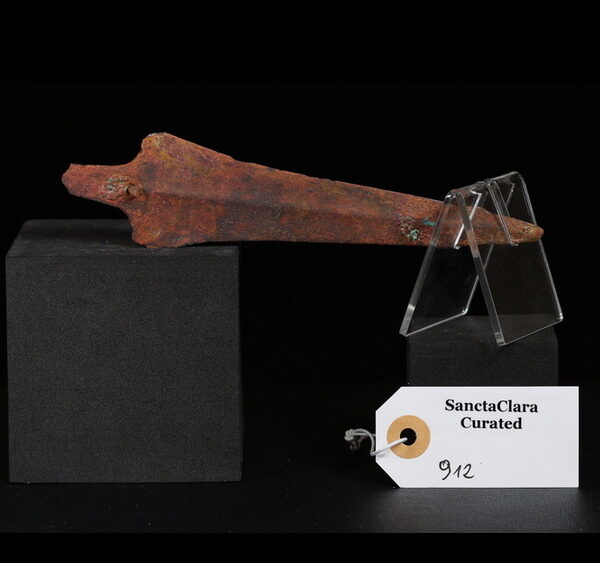
At one extreme stand the massive tanged bilobate points of Elam and Luristan — flat-bladed, rib-backed, leaf-shaped or deltoid heads that can reach 130, 140, or even 150 millimetres in total length. These are enormous by any standard of arrowhead design, and their classification as arrowheads rather than javelin heads is itself a matter of ongoing scholarly debate.
Several pieces in the Sancta Clara Collection — including Lot 117, a copper arrowhead of 142 millimetres from the Elamite period (approximately 3000 to 1600 BC) — illustrate this category. These objects are heavily built, with pronounced midribs, broad tangs, and thick, robust blades. They are far too heavy for use with a light composite bow at long range; if they were used as arrowheads at all, they must have been shot from powerful bows at relatively short distances, or possibly from crossbow-like devices.
The more likely interpretation for many of these oversized points is that they are javelin heads — light throwing spears rather than bow-launched projectiles. The distinction between a large arrowhead and a small javelin head is not always clear in the archaeological record, and ancient terminology may not have drawn the same categorical boundaries that modern typology attempts to impose.
The Miniatures: Scythian Trilobate Pyramids
At the opposite extreme are the tiny socketed trilobate and pyramidal points associated with the Scythian and related steppe cultures. Some of these points measure barely 18 to 25 millimetres in total length — smaller than a modern shirt button. They weigh only a few grams.
These diminutive arrowheads are not toys or models. They are fully functional military projectiles designed for a specific weapons system: the light but powerful composite recurve bow of the steppe nomad, made of laminated horn, sinew, and wood, which could drive even a tiny point with lethal velocity. The Scythian tactical doctrine relied not on heavy, destructive individual arrows but on overwhelming volumes of light, fast projectiles delivered in coordinated volleys from horseback. Each mounted archer carried multiple quivers, and the small size of the points meant that thirty or more arrows could fit in a single quiver.
The compact trilobate form — three small blades around a solid core — provided adequate penetration at the velocities achieved by the composite bow while remaining light enough for rapid shooting. Some Scythian points were reportedly dipped in poison, in which case even minimal penetration would be sufficient to deliver a lethal dose.
Between these extremes lies the full spectrum of human ingenuity applied to a single problem: how to deliver a piece of sharpened metal, as efficiently as possible, into a target at a distance. The solutions arrived at by Egyptian bow-makers, Assyrian military engineers, Scythian horse archers, Greek hoplites, and Roman legionary archers were as diverse as the cultures that produced them — and yet they all worked within the same fundamental constraints of physics, materials science, and human physiology.
Every arrowhead in a collection — from the smallest Scythian trilobate to the largest Elamite bilobate — is a frozen instant in this ongoing conversation between weapon and target, between attacker and defender, between innovation and tradition. Learning to read these objects is learning to read the logic of ancient warfare itself.
This article is part of the reference materials published by the Sancta Clara Collection at AncientBronzes.com. Content is provided for educational purposes and reflects observations drawn from direct study of the collection’s holdings and current archaeological scholarship.